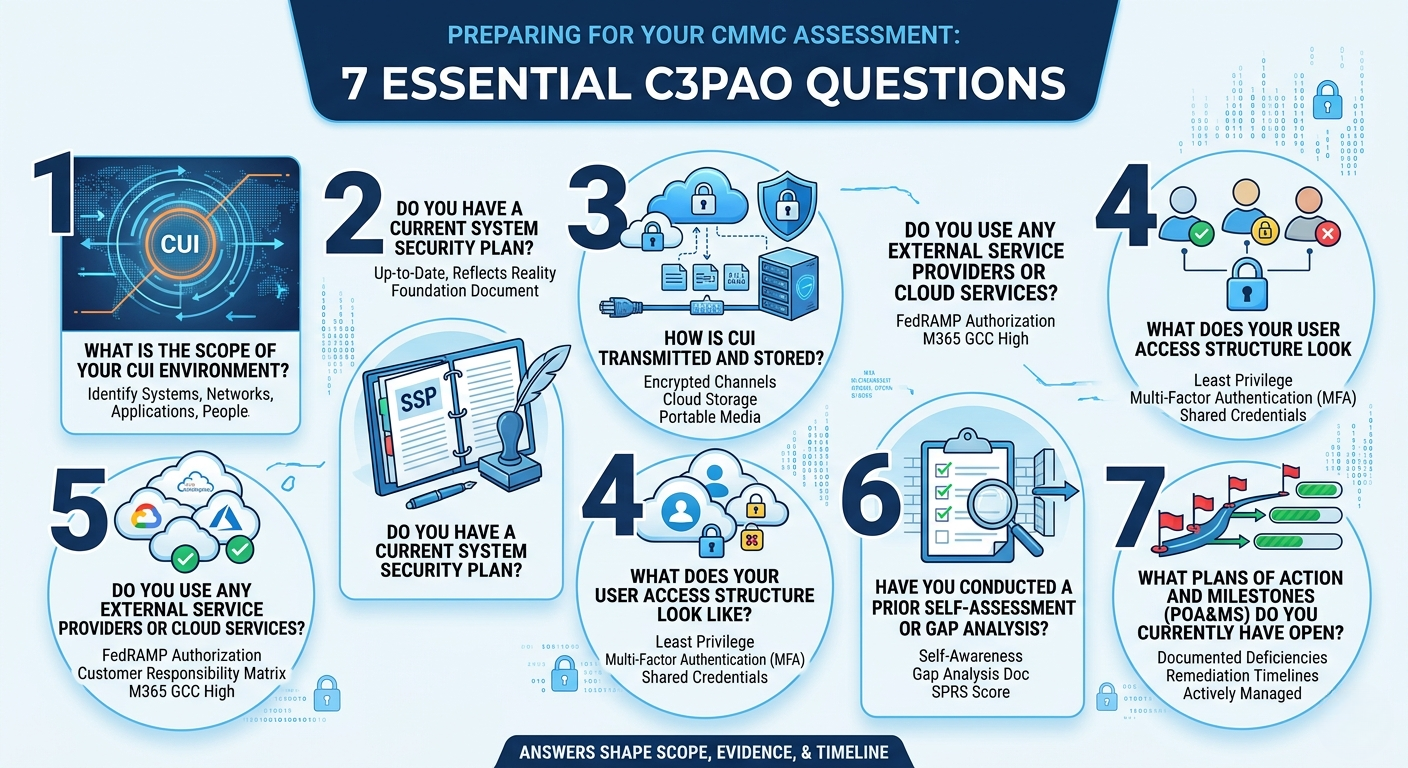
Before a Certified Third-Party Assessment Organization (C3PAO) ever opens your System Security Plan or starts walking through your practices, they need to understand your environment at a basic level. The opening conversation with a C3PAO is not a formality. What you say in those first exchanges shapes how the assessment is scoped, what evidence will be required, and how long the whole process is going to take.
Here are the seven questions that come up in nearly every initial engagement, and why each one matters more than it might seem.
1. What is the scope of your CUI environment?
This is the foundational question. The C3PAO needs to understand where Controlled Unclassified Information lives, moves, and gets processed in your organization. That means identifying systems, networks, applications, and even people who touch CUI on a regular basis.
A lot of contractors underestimate how broad this can get. If your engineering team uses a shared drive that also stores CUI, that drive is in scope. If a subcontractor receives CUI via email, their handling of that email is in scope. The boundary you draw here determines the size of your assessment, and the C3PAO will scrutinize it.
2. Do you have a current System Security Plan?
The SSP is the core artifact of a CMMC Level 2 assessment. The C3PAO will want to know whether you have one, how recently it was updated, and whether it accurately reflects your environment as it exists today, not how it was configured two years ago.
An SSP that is outdated, incomplete, or inconsistent with your actual practices creates problems during assessment. Assessors will compare what the document says against what they observe, and gaps between the two get documented as findings.
3. How is CUI transmitted and stored?
This question gets into the technical reality of your environment. The C3PAO wants to know whether CUI travels over encrypted channels, whether it sits in cloud storage and if so which cloud, whether portable media is used, and whether any of that data leaves your primary network boundary to reach remote workers or third parties.
The transmission and storage question often surfaces shadow IT problems. Organizations frequently discover during assessment prep that CUI has been stored in places nobody officially sanctioned, like a personal OneDrive or a shared Dropbox folder. Better to find that before the C3PAO does.
4. What does your user access structure look like?
Access control is one of the most frequently cited problem areas in CMMC assessments. The C3PAO will ask how you manage who gets access to CUI systems, how access is provisioned and revoked, and whether least privilege is actually being enforced or just written into a policy document nobody follows.
They will also ask about privileged accounts, service accounts, and shared credentials. If your IT team uses a single admin account that three people log into, that is going to come up. Expect questions about multi-factor authentication at this point as well.
5. Do you use any external service providers or cloud services?
Third-party and cloud service dependencies are a major scope consideration. The C3PAO will want to know which external providers touch your CUI environment, what their own compliance posture looks like, and whether you have documentation like FedRAMP authorizations or customer responsibility matrices to back that up.
This question often catches organizations off guard when it comes to Microsoft 365. If you are handling CUI in M365, the question of whether you are using the commercial environment or GCC High matters significantly. The licensing tier affects which compliance controls are actually available to you and which ones you are responsible for configuring yourself.
6. Have you conducted a prior self-assessment or gap analysis?
C3PAOs want to understand how self-aware you are about your own compliance posture. If you have done a gap analysis, that documentation gives the assessor useful context. It also signals that your organization has been actively working toward compliance rather than scrambling to prepare in the 60 days before the assessment date.
If you completed a SPRS self-assessment and submitted a score, be prepared to walk through how you arrived at that score. Assessors will compare your self-reported findings against what they observe during the assessment.
7. What Plans of Action and Milestones do you currently have open?
Open POA&Ms are not automatically disqualifying, but they need to be documented, realistic, and actively managed. The C3PAO will ask what deficiencies you have identified, what your remediation timelines look like, and what progress has been made since those items were first documented.
The concern here is not that you have open items. Most organizations do. The concern is whether those items are being tracked seriously or whether the POA&M is just a list that nobody looks at. An assessor can tell the difference fairly quickly.
What to Take Away From This
The first conversation with a C3PAO is not a soft introduction. The answers you give to these questions influence scoping decisions, evidence requests, and the overall trajectory of the assessment. Organizations that walk in with clear, accurate answers to all seven are in a fundamentally different position than those who are working through the answers in real time.
If you are preparing for an assessment and any of these questions would catch you off guard, that is worth addressing before you schedule your kickoff call.