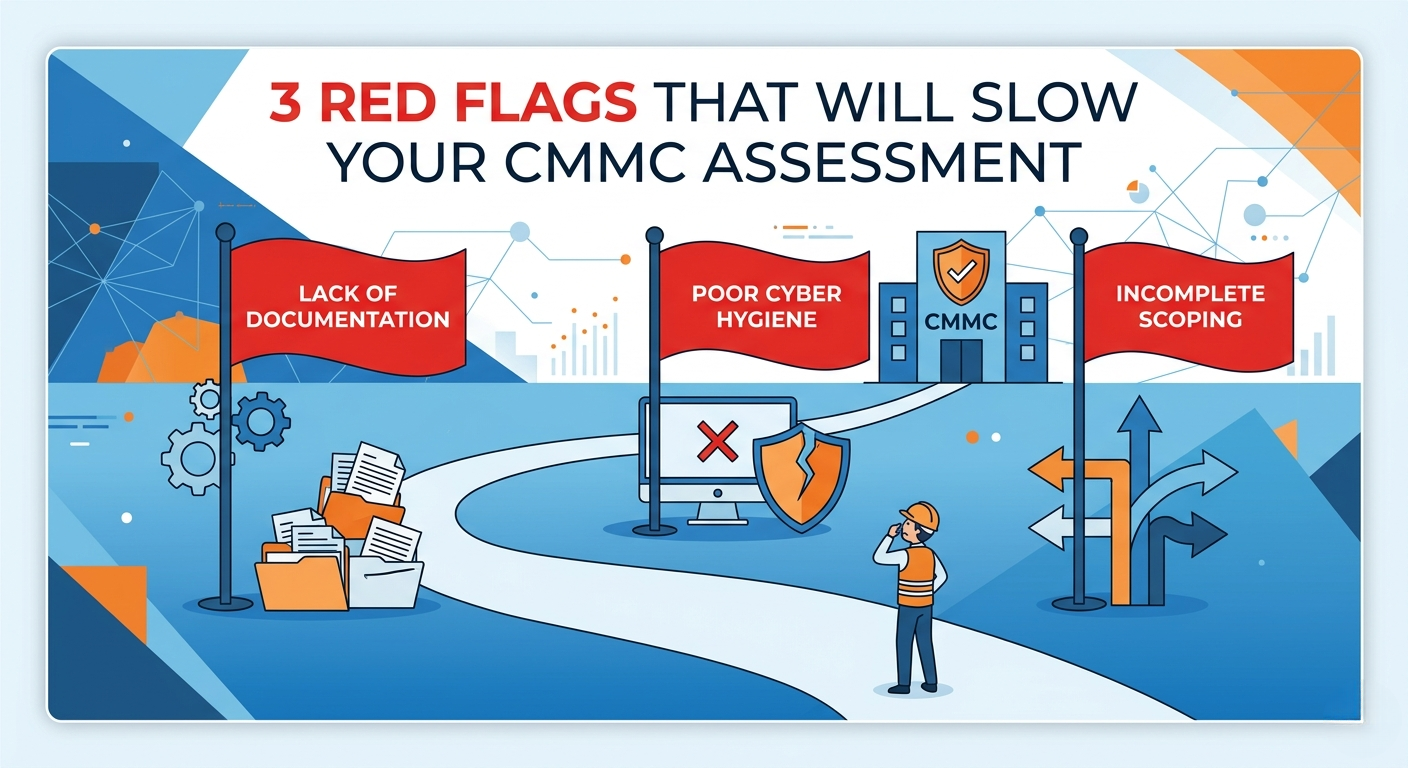
A CMMC Level 2 assessment is not a short process on its own. Depending on the size and complexity of your environment, you are looking at weeks of preparation, active assessment activity, and potential follow-up before a final determination is made. What a lot of organizations do not anticipate is how much longer that timeline can stretch when specific problems surface during the assessment itself.
C3PAOs are not trying to drag out your assessment. But when they encounter certain conditions, they are obligated to dig deeper, request additional evidence, and document what they find. Three issues come up repeatedly and consistently add time to the process.
Red Flag 1: Your SSP Does Not Match Your Actual Environment
The System Security Plan is supposed to be a living description of how your organization protects CUI. When an assessor reads it and then starts looking at your actual systems, those two things need to be consistent with each other. When they are not, the assessment slows down significantly.
Common disconnects include SSPs that describe network architecture diagrams that no longer reflect the current setup, reference tools or systems that have been decommissioned, or document security controls that are listed as implemented but are not actually configured or enforced. Assessors will walk your environment. They look at system configurations, pull screenshots, and interview personnel. A well-written SSP that does not match reality does not protect you. It creates a trail of discrepancies that have to be resolved.
When this situation comes up, the assessor cannot simply take your word for what the correct state is. They need documented evidence of the actual configuration, and that often means going back and collecting evidence that should have been gathered before the assessment started. That takes time on both sides.
The fix is not complicated, but it requires honest effort before the assessment starts. Review your SSP against your actual environment. Walk through it with someone who knows the technical reality of your systems, not just the compliance team. Update anything that is out of date before the C3PAO ever opens the document.
Red Flag 2: CUI Is Showing Up Outside Your Defined Boundary
Scope creep is one of the most disruptive things that can happen mid-assessment. You go in with a defined CUI boundary, the assessor starts looking at how data actually flows through your organization, and CUI turns up somewhere it was not supposed to be.
This happens more often than contractors expect. Someone on the project team forwarded a contract deliverable to their personal email because they were working from home. A subcontractor was given access to a folder that contained more than it should have. A shared collaboration tool that nobody thought to include in the scoping conversation has been used to exchange project files for two years. Each of these situations pulls new systems, services, or third parties into scope, and the assessment scope has to be adjusted accordingly.
Scope adjustments mid-assessment are not minor administrative edits. They mean the assessor now has to evaluate practices and controls in areas that were not part of the original plan. Depending on what they find, it can mean re-examining technical controls, collecting additional evidence, or rescheduling interviews with people who were not originally part of the process.
Preventing this requires doing real data flow analysis before the assessment, not just documenting where CUI is supposed to go. Follow the data through your actual workflows. Talk to the people who handle CUI day to day, because they often know about shortcuts and workarounds that never made it into any formal documentation.
Red Flag 3: Personnel Cannot Speak to Their Own Security Practices
CMMC assessments include interviews. Assessors do not just look at technical configurations and read documents. They talk to the people in your organization who are responsible for security practices, and they also talk to general staff who handle CUI as part of their regular work.
When the answers they get during those interviews do not align with what the SSP says, or when employees clearly do not know what they are supposed to do in basic security situations, that is a problem. It suggests that documented policies are not being followed in practice, which is exactly the kind of gap an assessment is designed to surface.
This shows up in a few specific ways. An IT administrator cannot explain how privileged access is managed. A project manager does not know the process for reporting a potential CUI spill. An end user has never received security awareness training and cannot name a single practice they follow when handling sensitive information. Any of these responses sends the assessor back to look at controls more carefully and collect additional evidence.
Documentation that nobody knows about is not a functioning control. Before your assessment, make sure the people who will be interviewed understand what your policies require, why those requirements exist, and what they personally do to fulfill them. This is not coaching people to give rehearsed answers. It is making sure your security practices are actually practiced, which is the point of the whole process.
The Common Thread
All three of these issues share the same root cause: a gap between what an organization has written down and what is actually happening. CMMC assessments are designed to find that gap. Organizations that have done the work to close it before the assessment starts move through the process faster and with fewer surprises.
If you are preparing for a CMMC Level 2 assessment and are not sure whether any of these situations apply to your organization, a pre-assessment readiness review is worth the investment. Finding these issues on your own timeline is a much better position than finding them during a formal assessment.