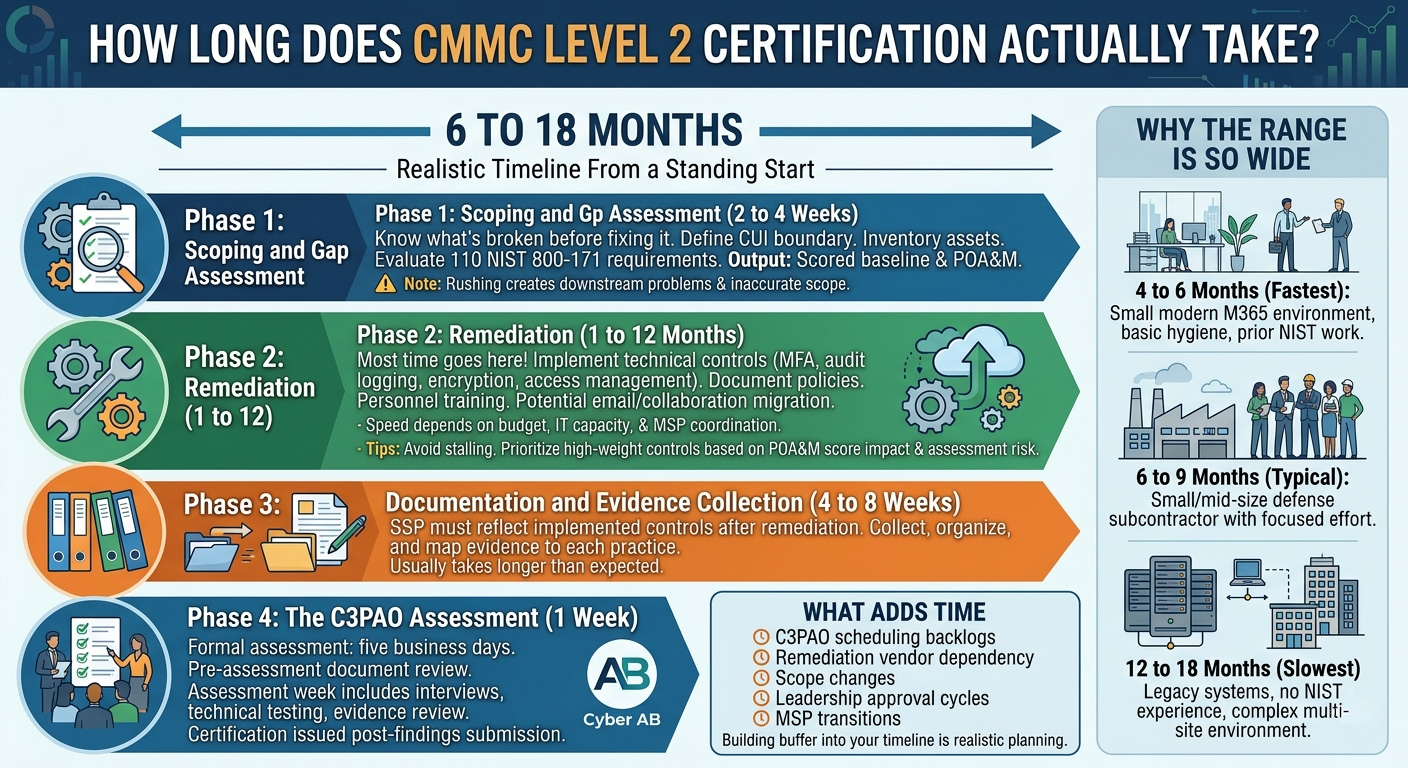
The realistic answer is 6 to 18 months from a standing start. Where you land in that range depends on your current posture, how much remediation you need, and how fast your organization can execute on fixes.
Why the Range Is So Wide
The timeline is driven almost entirely by the gap between where you are and where you need to be. An organization with a modern M365 environment, basic security hygiene already in place, and two dozen employees can move from gap assessment to C3PAO assessment in four to six months. An organization with legacy systems, no prior NIST 800-171 work, and a complex multi-site environment may realistically need 12 to 18 months.
Most small to mid-size defense subcontractors fall somewhere in the middle: six to nine months with focused effort.
Phase 1: Scoping and Gap Assessment (2 to 4 Weeks)
Before you can fix anything, you need to know what is broken. This phase defines your CUI boundary, inventories your assets, and evaluates your current implementation of all 110 NIST 800-171 requirements. The output is a scored baseline and a POA&M that drives everything that comes next. Rushing this phase creates problems downstream – an inaccurate scope means you remediate the wrong things.
Phase 2: Remediation (1 to 12 Months)
This is where most of the time goes. Remediation includes technical controls (MFA, audit logging, encryption, access management), policy and procedure documentation, personnel training, and for many organizations, an email and collaboration environment migration. Speed depends on budget, internal IT capacity, and how much coordination is required with MSPs or other vendors managing your environment.
Organizations that try to do everything at once typically stall. Prioritizing by POA&M score impact and assessment risk – starting with the high-weight controls assessors scrutinize most – is a faster path than working through the list sequentially.
Phase 3: Documentation and Evidence Collection (4 to 8 Weeks)
Your SSP needs to accurately reflect the controls you have implemented after remediation. Evidence needs to be collected, organized, and mapped to each practice before the assessment. This phase typically takes longer than organizations expect because pulling together artifacts from multiple systems, vendors, and people is not fast when you are doing it for the first time.
Phase 4: The C3PAO Assessment (1 Week)
The formal assessment is typically five business days. Document review happens in advance. The assessment week covers interviews, technical testing, and evidence review for each in-scope practice. After the assessment, the C3PAO submits findings to the Cyber AB, and the certification determination is issued – typically within a few weeks of the assessment closing.
What Adds Time
C3PAO scheduling backlogs. Remediation items that depend on vendor action. Scope changes that invalidate earlier documentation work. Leadership approval cycles for policy documents. MSP transitions when your current IT provider cannot support the controls you need. All of these are real and common – building buffer into your timeline is not pessimism, it is planning.
Init Cyber builds realistic timelines into every engagement based on your actual starting posture. Fixed-fee or hourly. Contact us today to see how we can help.